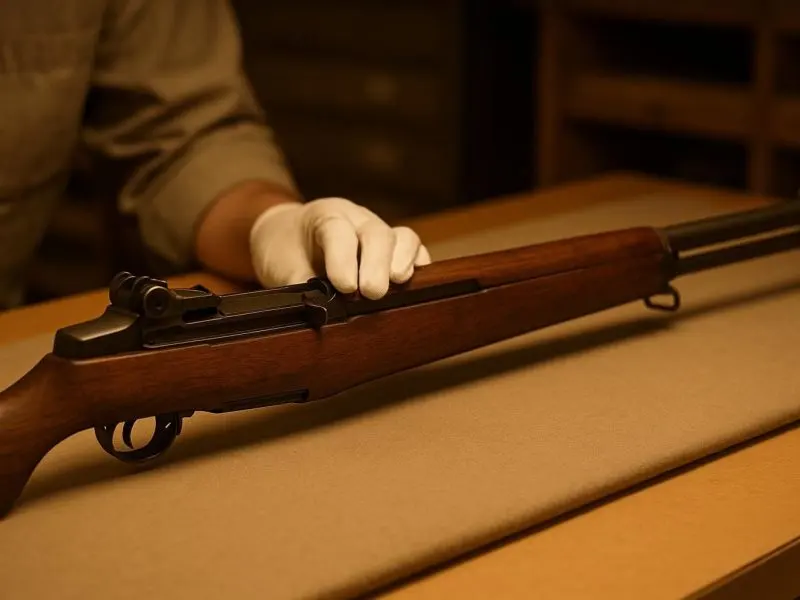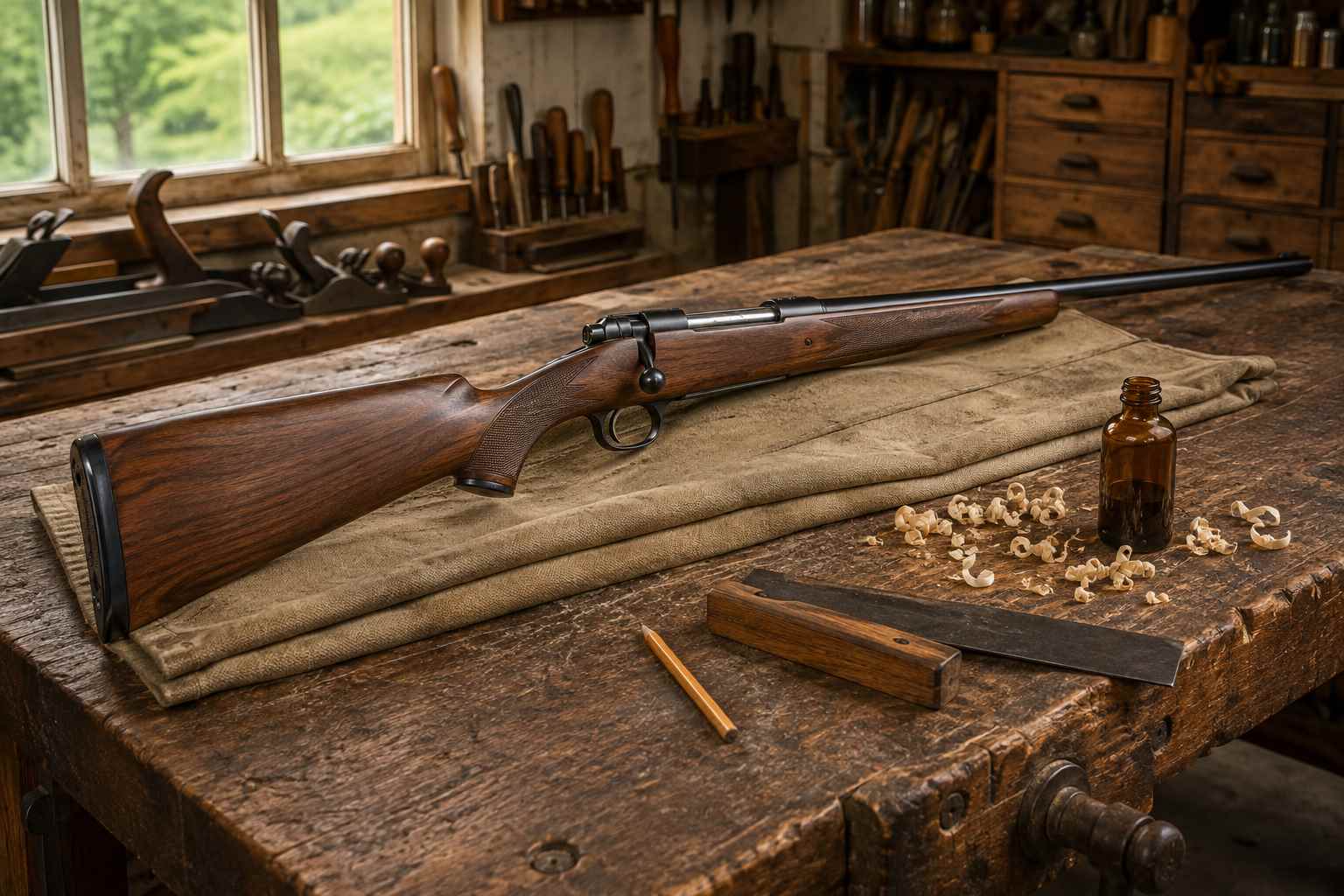
A stock can look untouched while hiding a repaired wrist. A barrel can retain crisp markings even when its bore has been altered by wear, corrosion or later work. Such contradictions are why assessment should begin with limits, not appearance. Before examining any firearm, confirm that it is unloaded, keep the muzzle pointed safely, and stop if its condition or operating status is uncertain. A qualified gunsmith or other trained professional should address questions that visual inspection cannot answer. Follow current official guidance on possession, transfer, marking and display.
Start with identity before condition
The first question is not whether an object looks desirable, but what it is.
Record the maker's markings, model designation, serial or identifying number where legally and safely appropriate, proof or inspection marks, caliber or chamber markings, and distinctive construction details. Do not assume a familiar outline proves a model. Manufacturers changed markings, parts and production methods, while owners sometimes assembled components from different firearms.
This sequence matters because condition has meaning only in context. A replaced part may be a defect in originality, a historically reasonable repair or a later safety improvement, depending on the firearm and evidence. Without secure identity, later conclusions rest on a weak foundation.
How damage becomes a condition story
Firearm condition is not a single grade but a chain of causes and consequences. Start with the material: wood can split, compress, shrink or absorb moisture, while steel can pit, corrode, wear or lose sharp edges through cleaning and handling. Ask what produced the change-impact, neglect, repeated use, aggressive polishing, poor storage or documented repair-and what it affects: appearance, fit, strength, function, historical character or safety.
A scratch and a repaired crack are not equivalent. A crack may matter more structurally, especially around a stock's wrist or tang. Surface oxidation is not automatically deep damage, but it warrants closer inspection. Note its location, depth, continuity, evidence of intervention and effect on safe operation. Photographs document observations but cannot replace inspection of hidden surfaces, tight joints or internal components.
The stock: structure before finish
Evaluate the stock as a load-bearing component, not decoration. Inspect the wrist, head, inletting, recoil-bearing areas, butt, checkering and cracks that follow the grain or run across it. Look for interrupted finish lines, uneven borders, filled holes, fresh-looking wood around old hardware and color changes that may indicate sanding or localized repair. Refinishing may leave the stock sound, but it changes the evidence of its past.
Fit creates a technical chain: removing wood around metal can change contact patterns, while an opened crack or shifted repair can alter stress distribution. Do not test a questionable firearm by firing it. A competent gunsmith can determine whether a suspected defect requires no action, controlled repair or removal from service.
Distinguish honest wear from altered structure. Handling marks, softened checkering and finish loss can record use; cracks, crushed wood, replacement sections and conspicuous inletting deserve separate documentation.
What the barrel can and cannot reveal
Assess the barrel in stages: exterior identity, surface condition, bore condition and functional implications. Check whether markings remain legible and whether the exterior shows pitting, bulges, dents, unusual tool marks or an inconsistent finish. Examine the bore only with the firearm unloaded and handled safely. A light can reveal broad surface condition but cannot establish every internal dimension or whether firing is safe.
Pay attention to the barrel-to-receiver transition, muzzle and any apparent alteration. Muzzle wear may reflect use or cleaning, while rebluing, shortening or other changes can affect originality and the interpretation of markings. None of these observations alone proves a defect or historical conclusion.
A gunsmith should evaluate safety-critical questions, including chamber condition, mechanical integrity and whether firing is appropriate. The record should distinguish what was seen, what a qualified professional measured and what remains unverified.
Provenance turns an object into a documented history
Provenance is evidence connecting a specific object to a claimed history. It may include original records, dated photographs, lawfully available transfer documents, family papers, institutional references, matching markings or a continuous chain of custody. Each source has different evidentiary weight.
Treat provenance as a set of claims, not a single story. A handwritten note may preserve context without proving every detail. A photograph may confirm appearance at one time while leaving earlier changes unresolved. A serial number connects records to an object only when the marking and record are correctly interpreted.
The firearm must agree with the paperwork. Contradictions do not automatically disprove the history, but require explanation. Record each source, date, wording and limitation, and do not present an attractive attribution as fact when evidence is incomplete.
Originality is a question of degree
Originality is rarely all or nothing. A firearm may retain its original stock and barrel while having replacement screws, springs, sights or finish. Another may be assembled from period-correct parts but lack its original configuration. State the distinction precisely.
Separate original, period replacement, later replacement, repaired, refinished, modified and unknown. Examine screw slots, finish transitions, contour changes, wear patterns, markings and the relationship between wood and metal. Consistent wear can support a conclusion but is not proof: parts can age differently, and skilled later work can imitate older surfaces.
A modification may reduce factory originality while documenting use in its own era. Ask what changed, when and why, and how securely that timing can be established.
A record that survives review
A disciplined assessment should let another reader follow the reasoning. Keep one compact record for each firearm:
– Identity: markings, model interpretation and unresolved questions.
– Safety status: unloaded condition, handling limits and any professional examination.
– Condition: wood, metal, bore, finish and structural observations.
– Originality: confirmed original parts, replacements, alterations and unknowns.
– Provenance: source for each historical claim and any contradiction.
– Evidence: dated photographs, documents and the person or institution responsible for technical findings.
This approach prevents one attractive feature from dominating the assessment and keeps historical context, craftsmanship and safety in the same frame. The most credible account identifies both what the object shows and what it cannot yet prove.